

Romy vs Polsia
Romy vs Polsia: approval-led or autonomous GTM?
Polsia is designed to keep planning, coding, and marketing within the permissions you set. Romy builds and runs the go-to-market roadmap around your product, but every external move waits for you.
Choose Polsia if you want an AI system to keep planning and executing company work, including coding and marketing, without item-by-item check-ins, and are comfortable controlling it through permissions, budgets, pausing, and steering.
Choose Romy if you have built or nearly built the product and want a system to work out the market, positioning, channels, goals, and next GTM moves, while every external action waits for your approval.
What does Polsia actually do?
Polsia is positioned to create, plan, and operate company work across coding, marketing, customer interaction, and operations. God Mode can continue for a selected period without check-ins, while the product builder can pause or steer it. Romy is centered on the commercial choices around a built product. Both can plan and support product builder work. The difference is what each is designed to own and where the system waits.
The difference is where the system waits.
- Starting job: Polsia can help create and operate the company. Romy begins with the product and builds the go-to-market system around it.
- External-action model: Polsia can continue inside enabled permissions until stopped or steered. Romy asks for approval before each external action.
- Primary scope: Polsia spans coding, marketing, and operations. Romy connects GTM strategy, content, relationships, operations, money, and knowledge around commercial progress.
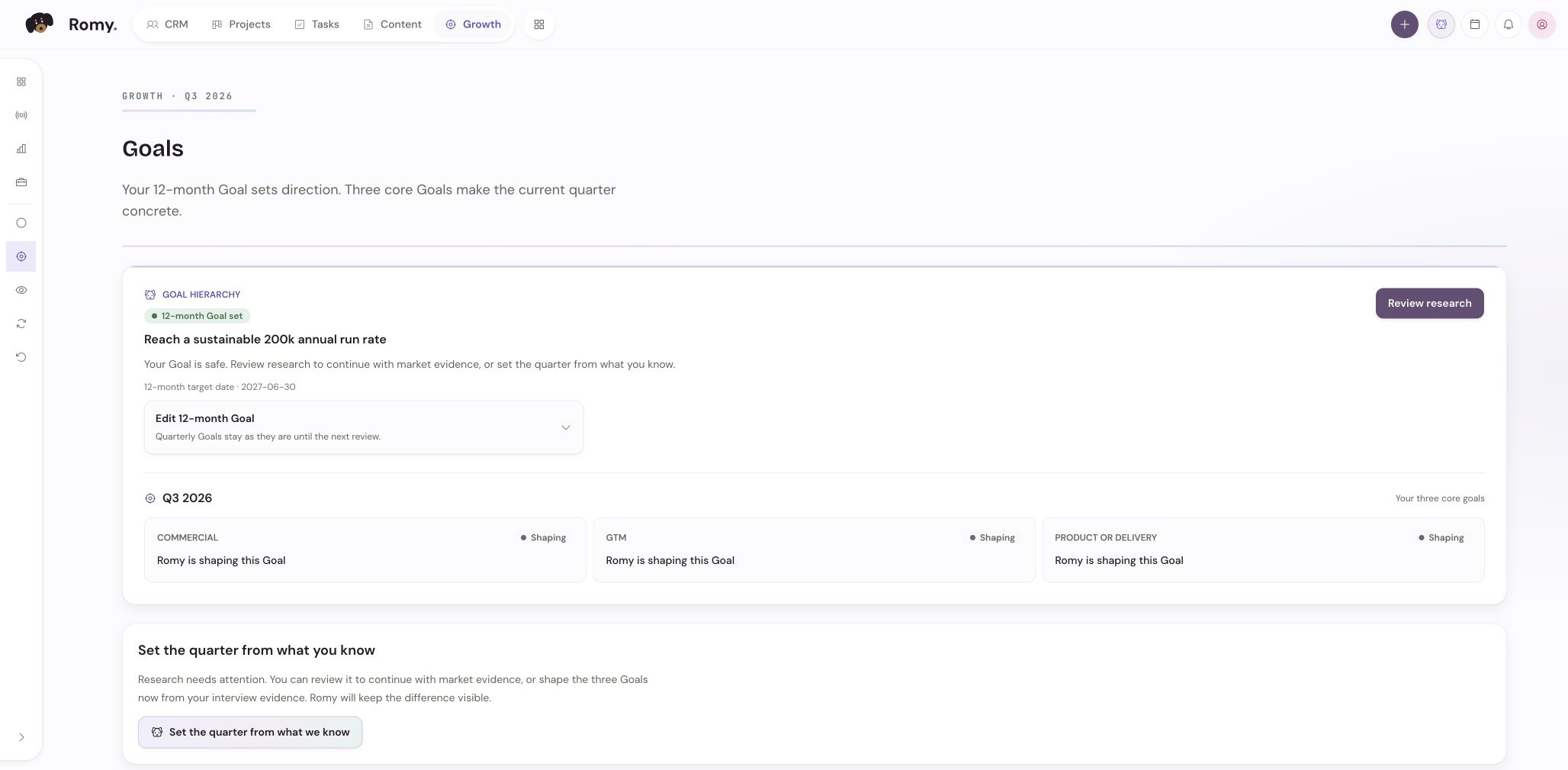
Polsia: grant permissions and a time window, work continues, product builder pauses or steers. Romy: prepare the specific external move, show source and reason, product builder approves, edits, or rejects, result updates the next recommendation.
Same objective. Different point of intervention.
RelayFox is a working beta that turns support conversations into a prioritized product backlog. It has five friendly users, no repeatable acquisition route, and eight founder GTM hours per week. (Illustrative company and scenario.) The shared objective: find and activate the first 25 non-friendly users.
The product builder sets the objective and enables relevant tools, credentials, permissions, schedules, and budgets. Polsia formulates company plans and tasks. A timed God Mode session starts. Polsia completes a task, plans the next, and continues without item-by-item check-ins. The product builder can pause or steer the work in chat when needed. The system can span coding, marketing, research, pipelines, and operations within current product boundaries. (Polsia workflow: based on official product descriptions; interface and output may differ.)
Romy reads RelayFox’s product, ambition, evidence, constraints, and available time. It compares plausible first audiences. It recommends one starting audience and explains why alternatives are lower priority. It builds the roadmap to 25 active users. It ranks the first commercial move for today. It prepares an external action, such as a founder-community reply or interview invitation. It shows the evidence, goal, assumption, and reason for the move. The product builder approves, edits, or rejects it. The resulting conversations, activation, and objections return to the roadmap, and the next recommendation changes accordingly. (RelayFox and outcomes: illustrative. Romy proof: current product patterns with sanitized data.)
Polsia continues within a granted period or permission until stopped or steered. Romy waits for review of the specific outward-facing move before it goes out. (Conceptual workflow, not a current native integration.)
When is Polsia the better choice?
Choose Polsia when continuous autonomous throughput, coding, and company-wide execution are the job, and intervention by exception fits.
Polsia capability ledger · official product descriptions
- Continuous autonomous throughput across company work
- Coding and deployment inside the same broad system
- Company creation and operation
- Timed God Mode sessions from one hour to seven days
- Pause and steer in chat when needed
- Marketing, customer work, and operations within enabled permissions
If the product builder wants one agent to keep doing broad company work and is comfortable intervening by exception, Polsia is the clearer fit.
When is Romy the better choice?
Choose Romy when every external move should be explained and approved before it represents the product builder.
Romy capability ledger · current product patterns
- Fixed commercial method covering audience, position, channel, goal, and measurement
- Strategy stored as product state, not a one-time document
- The reason and evidence behind today’s recommended move
- Action-level external approval: approve, edit, or reject
- Relationships, commitments, money, and outcomes feeding the roadmap
- Approval, edits, rejections, and actual results making the next recommendation smarter
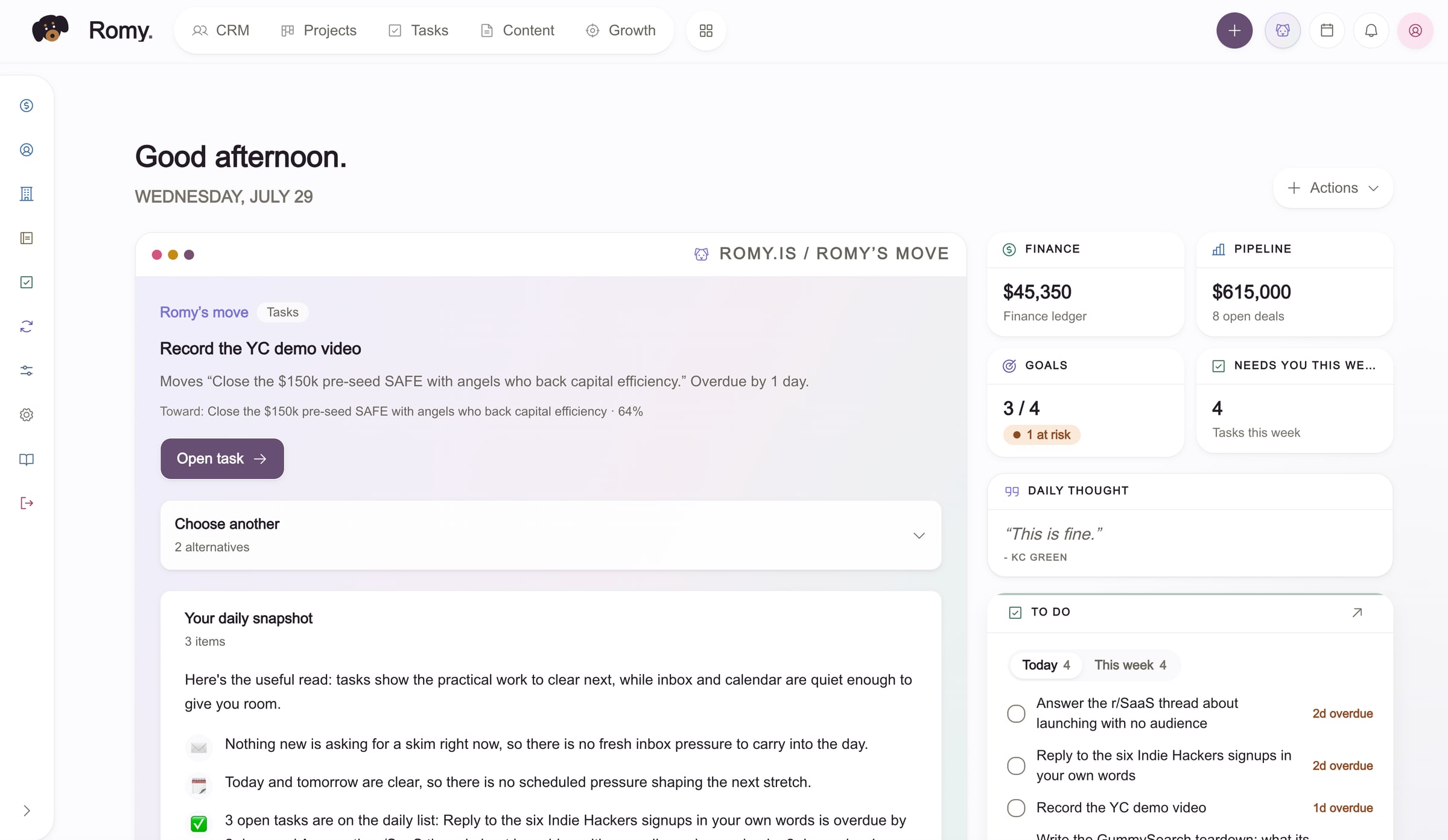
Romy doesn’t replace Polsia’s autonomous execution infrastructure. Its value is the fixed GTM method, daily queue, and approval loop already built into the product.
Comparison table
Eight dimensions where the two products diverge.
The same monthly headline can buy a different control model.
Whether one product replaces the other depends on the job. Romy may replace Polsia when the product exists and the main need is approval-led GTM rather than broad company creation, coding, or autonomous operation. Polsia may replace Romy when continuous company execution and coding matter more than a fixed GTM method or item-by-item external approval.
Both may make sense when Romy owns commercial direction and Polsia owns clearly bounded product or internal execution. Assign one source of commercial direction. Separate credentials and prevent overlapping marketing actions or contradictory external work. (Conceptual workflow, not a current native integration or tested joint operating model.)
Romy and Polsia can both present a $49 monthly entry, but the price buys a different operating model. Romy’s planned price is for an approval-led GTM system. Polsia’s subscription supports a broader autonomous company platform, while long-running God Mode has separate time-based pricing.
Facts checked: 29 July 2026
- Romy
- Free during beta. Billing isn’t open. Planned public-launch price: $49/month, billed monthly, for the complete Romy system.
- Polsia subscription
- Official July 2026 Polsia guides describe a $49/month subscription. Verify the live checkout before relying on this figure.
- Polsia God Mode
- Starts at $19 for one hour and can run from one hour to seven days. The official announcement says the effective hourly rate is below $6 when run for a week.
Is God Mode needed? For how long? Which services, permissions, ads, payments, or credentials are enabled? Which system owns external work? Is Romy publicly billable yet?
Questions
Common questions about Romy, Polsia, and how they compare.
Does Polsia require approval before every action?
No. God Mode is designed to continue without check-ins for a selected period within enabled permissions and settings.
Can I control Polsia?
Yes. Its official description says the user can pause it and steer it in chat.
Does Romy publish or send without me?
No. Every external move waits for approve, edit, or reject.
Which product can build my software?
Polsia publicly includes coding and deployment. Romy isn't a software-building system.
Does Polsia do strategy?
Polsia plans business work and tasks. Romy's distinction is a fixed GTM method, not strategy versus none.
Which is better for running unattended?
Polsia is the clearer fit because continuous autonomous work is central to the product.
Which is better for a reputation-sensitive product builder?
Romy is the clearer fit when every external action should be inspected before it represents the product builder.
Are both products $49/month?
Romy plans to charge $49/month and is free during beta. Official Polsia guides describe $49/month, while God Mode also has time-based pricing.
Can I use both?
Potentially, but define one source of commercial direction and prevent overlapping external actions. No live integration is implied.
Choose the point where you want the system to wait.
Polsia product and pricing information was last verified on 29 July 2026 from the official sources linked above. Features and prices can change.
Romy’s method is grounded in two decades of commercial go-to-market work and a corpus of 5,300 strategy documents.
Facts checked: 29 July 2026

Need the GTM roadmap with every external move waiting for you?
Join Romy early access to build the commercial roadmap, rank the daily work, and approve every move before it represents you.