

Romy vs Origami
Romy vs Origami: which should a solo founder use?
Origami searches the live web for hard-to-find businesses and people. Romy decides whether prospecting is the right growth bet, defines the offer, and connects the results to the rest of the company.
Choose Origami if you can describe the businesses or people you need and want an AI prospecting system to search live sources, build and enrich the list, retrieve contact data, and run or support outreach.
Choose Romy if you need to decide who to pursue, what to offer them, whether prospecting is the right route, which other channels matter, and how the resulting work connects to the whole business.
What does Origami actually do?
Origami’s current product uses natural-language prompts and live-web sources to build structured prospect tables, enrich companies and people, retrieve contacts, analyze existing accounts, build lookalikes and market maps, identify signals, sequence outreach, and support programmatic enrichment. Both products can help define an audience and act on market evidence. Origami finds the prospects for a described route. Romy decides whether that route deserves priority.
A list and a market decision are different outputs.
- Primary job: Origami finds and enriches prospects. Romy chooses and runs the broader GTM plan.
- Starting input: Origami works from a customer description or existing accounts. Romy begins with the product, ambition, evidence, constraints, and possible routes.
- Commercial scope: Origami centers discovery, enrichment, and outreach. Romy connects acquisition with positioning, relationships, operations, money, and knowledge.
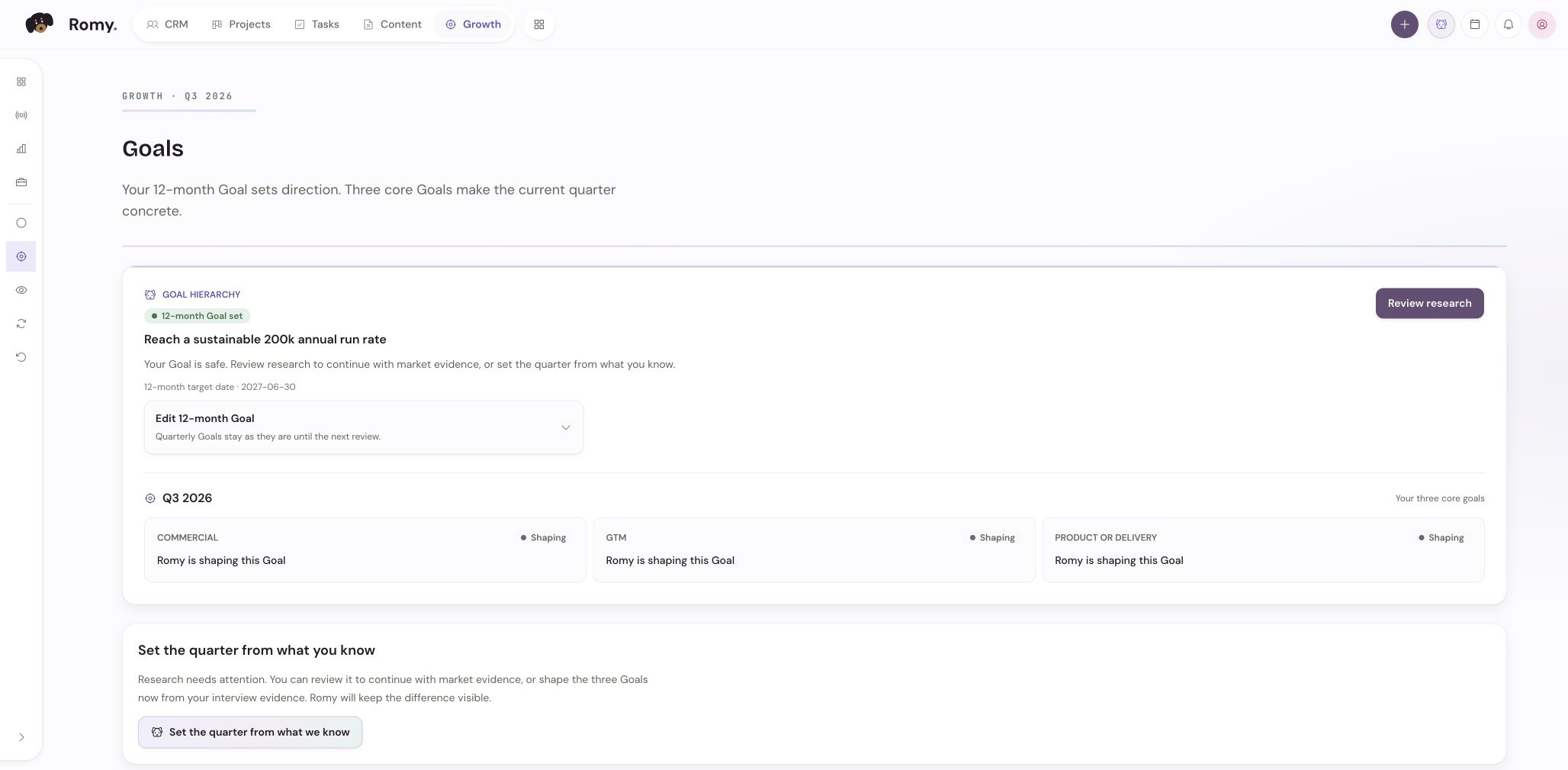
Prospect discovery answers who matches. Route selection answers whether the profile, offer, and channel deserve the business’s next commitment.
Decide the wholesale test before building the list.
Fieldnote Goods sells refillable botanical travel candles at $8,000 monthly D2C revenue, with strong repeat purchase, rising paid-acquisition cost, 45 percent gross margin before wholesale discounts, and six weeks of inventory. (Illustrative company and goal.) The shared input: find independent gift stores in the Northeast that stock refillable home fragrance products and identify the owner or buyer.
The product builder describes the retailer profile in natural language. Origami searches live web sources and business directories, returns structured companies, and refines location, store type, product mix, and other criteria. It enriches company and buyer contacts using provider waterfalls by plan. The product builder exports the list or uses the Sequencer on a qualifying plan. Signals and market-map fields help prioritize. (Origami workflow: based on official product descriptions.)
Origami answers: which stores and people match, what sources support the result, and how can they be enriched or contacted?
Romy reads Fieldnote’s product, repeat purchase, acquisition cost, margin, inventory, capacity, and product builder time. It compares wholesale with creators, referrals, content, marketplaces, and paid work. It defines the first retailer profile, offer, geography, order size, and success condition. It builds a 30-store test into the roadmap, prepares the first approved relationship move, tracks conversations, samples, orders, margin, production work, and follow-up, and changes the channel priority based on qualified interest, order economics, repeatability, and operational load. (Fieldnote Goods and data: illustrative.)
Romy answers: is independent retail the right next route, what profile and offer should be tested, how many accounts fit capacity, and what result justifies continuing?
Origami is the stronger list and contact tool. Romy is the stronger route and company system. (Handoff: conceptual, not a current native integration.)
When is Origami the better choice?
Choose Origami when the prospect profile and route are known and discovery is the bottleneck.
Origami capability ledger · official product descriptions
- Natural-language prospect discovery and live-web research
- Niche and local business coverage
- Structured tables and company and people enrichment
- Contact waterfalls and ICP Builder
- Lookalikes, market maps, and signals
- CSV export, sequencing, and API enrichment
- Low-priced self-serve entry
If the profile is known and discovery is the bottleneck, Origami is the clearer specialist choice.
When is Romy the better choice?
Choose Romy when prospecting must compete with D2C, creators, content, community, partnerships, marketplaces, referrals, and product-led routes.
Romy capability ledger · current product patterns
- Routes compared: wholesale, D2C, creators, content, community, partnerships, marketplaces, and referrals
- The offer and audience built into the roadmap
- Margin, time, inventory, and operating constraints in the decision
- Relationships managed as part of the wider company context
- Operational work ranked alongside acquisition
- Every external move under explicit product builder approval
- Results and outcomes making the next recommendation smarter
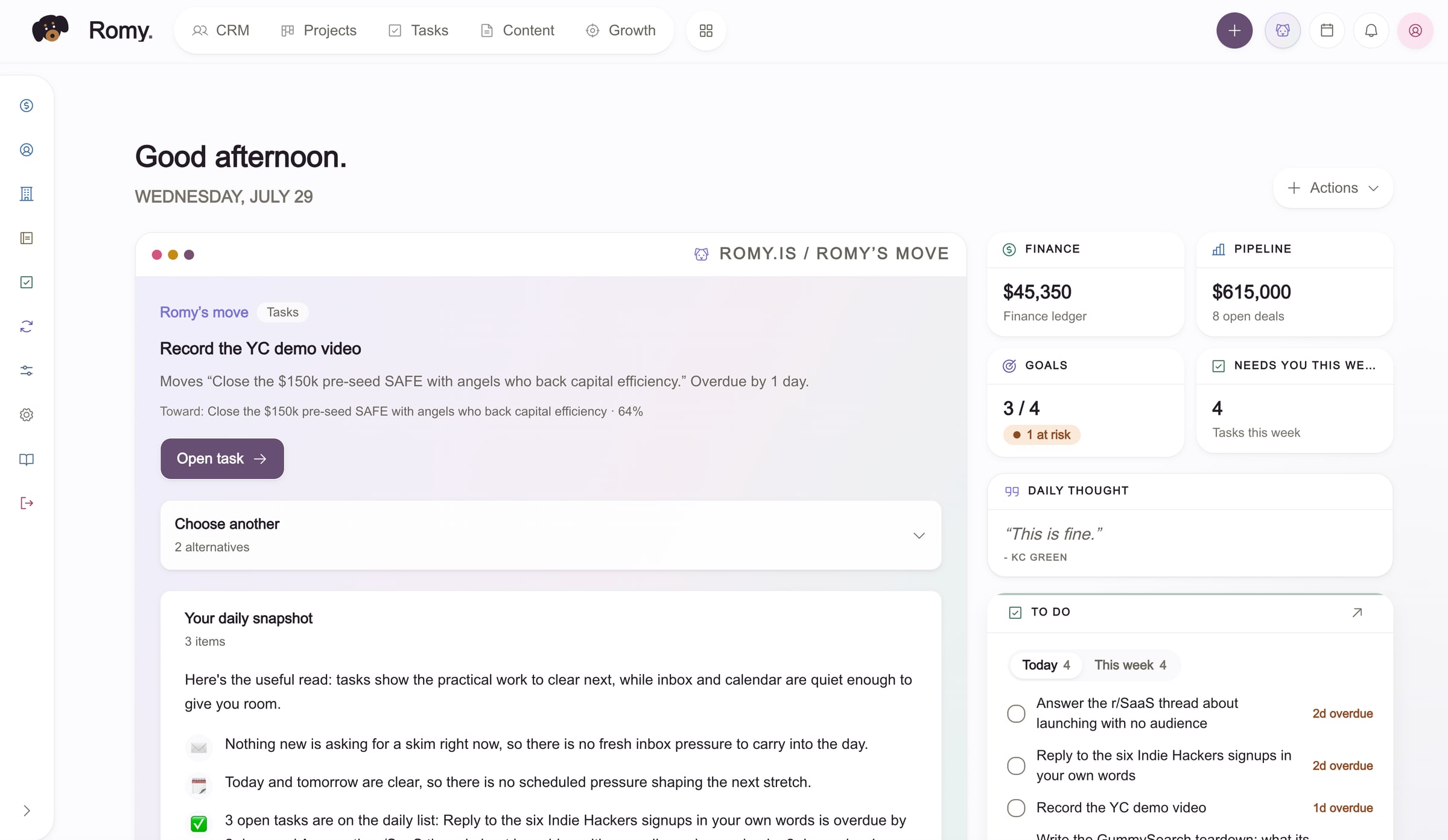
Romy doesn’t replace Origami’s discovery infrastructure. Its value is the route selection, daily queue, and operating loop already built into the product.
Comparison table
Eight dimensions where the two products diverge.
A prospecting plan and a full GTM system price different jobs.
Whether one product replaces the other depends on the job. Romy may replace Origami when the real job is route choice and a small manually sourced test, not specialist prospect discovery or contact data. Origami may replace Romy when the prospect profile, offer, and route are settled and discovery is the bottleneck.
Both may make sense when Romy defines the bounded prospecting test and Origami finds and enriches the prospects. (Conceptual workflow, not a current native integration.) Don’t build a large list until the offer, economics, capacity, and success condition are defined.
Facts checked: 29 July 2026
- Romy
- Free during beta. Billing isn’t open. Planned public-launch price: $49/month, billed monthly, for the complete Romy system.
- Origami Free
- $0 with 1,000 one-time credits, 20 agent messages, one workspace, and 30 rows per table. It doesn’t include CSV export, contact information, or the Sequencer.
- Origami Starter
- $29/month with 2,000 credits per month, unlimited team members and agent messages, 40 workspaces, unlimited table rows, CSV export, contact information, and the Sequencer under current plan terms.
- Origami Enterprise
- Custom pricing and capacity.
Origami Starter is less expensive than Romy’s planned price because it buys a focused prospecting workflow. Romy’s planned price buys the wider GTM and business system, but doesn’t include Origami’s specialist discovery by default.
How many searches? What does a credit buy? Is contact data, export, or sequencing required? Is another CRM or sending system needed? Can the business support the chosen route?
Questions
Common questions about Romy, Origami, and how they compare.
Is Romy an Origami alternative?
Only when the job is choosing the wider GTM route. Romy isn’t a like-for-like replacement for Origami’s discovery, contacts, tables, or sequencing.
Can Origami build an ICP?
Yes. Its current ICP Builder can analyze accounts, identify attributes, score matches, map the market, find lookalikes, and identify negative patterns.
Which is better for local or niche businesses?
Origami is the clearer specialist choice because live-web prospect discovery is central to the product.
Which is better for deciding between wholesale and D2C?
Romy is the clearer fit because the route, economics, operations, and wider roadmap are the job.
Does Romy provide verified contact data?
Don’t assume it does. This is Origami’s stronger product area.
Can they work together?
Conceptually, yes. Romy can define the test and Origami can find and enrich the prospects. No native integration is implied.
What does Origami Free include?
It currently includes 1,000 one-time credits and limited workspace use, but not contact data, CSV export, or sequencing.
Which is cheaper?
Origami Starter is currently $29/month. Romy’s planned price is $49/month and beta is free. They buy different jobs.
Is Origami only for B2B SaaS?
No. Its positioning includes niche, local, non-tech, ecommerce, creator, and fragmented prospect markets.
Choose the route before you scale the list.
Origami product and pricing information was last verified on 29 July 2026 from origami.chat and its official documentation. Features, limits, and prices can change.
Romy’s method is grounded in two decades of commercial go-to-market work and a corpus of 5,300 strategy documents.
Facts checked: 29 July 2026

Need to decide the route before building the list?
Join Romy early access to choose the route, define the test, and connect the results to your wider commercial plan.