

Romy vs Claude
Romy vs Claude: should you build your own GTM system?
Claude gives you flexible intelligence, Projects, memory, research, files, coding, and connectors. Romy turns a tested GTM method into a living roadmap and the right commercial work each day.
Choose Claude if you want highly capable general-purpose AI for research, writing, analysis, coding, files, Projects, connectors, and varied work, and you are willing to define the GTM method, data structure, routines, and quality controls yourself.
Choose Romy if you want a purpose-built system that diagnoses the product’s market, creates and stores the GTM roadmap, ranks commercial work each day, connects it to the business, and requires approval before external action.
What can Claude already do for go-to-market?
A credible Claude workflow can use Projects, instructions, project knowledge, memory, Research, connectors, files, code execution, Cowork, skills, and scheduled work where supported.
A capable product builder can use those building blocks to research a market, compare audiences, create a strategy, maintain tasks, draft work, and update the plan.
Both products can research, remember context, plan, draft, use connected tools, and help a product builder act.
Claude and Romy are different product layers. Claude supplies general intelligence and tools. Romy supplies the commercial method, state, workflow, controls, and accumulated business context around that intelligence.
The difference isn’t the quality of one answer.
Both products can produce a strong GTM analysis. The decision is what exists before the prompt, what persists after the answer, and who maintains the relationships between strategy and work.
- Generality: Claude is designed for many kinds of knowledge work. Romy is designed around one commercial job.
- Method ownership: Claude lets the user create and direct the process. Romy supplies the GTM method and expected sequence.
- Default product state: Claude can store project knowledge and memory. Romy structures audience, positioning, channels, goals, relationships, work, money, and outcomes as parts of one commercial loop.
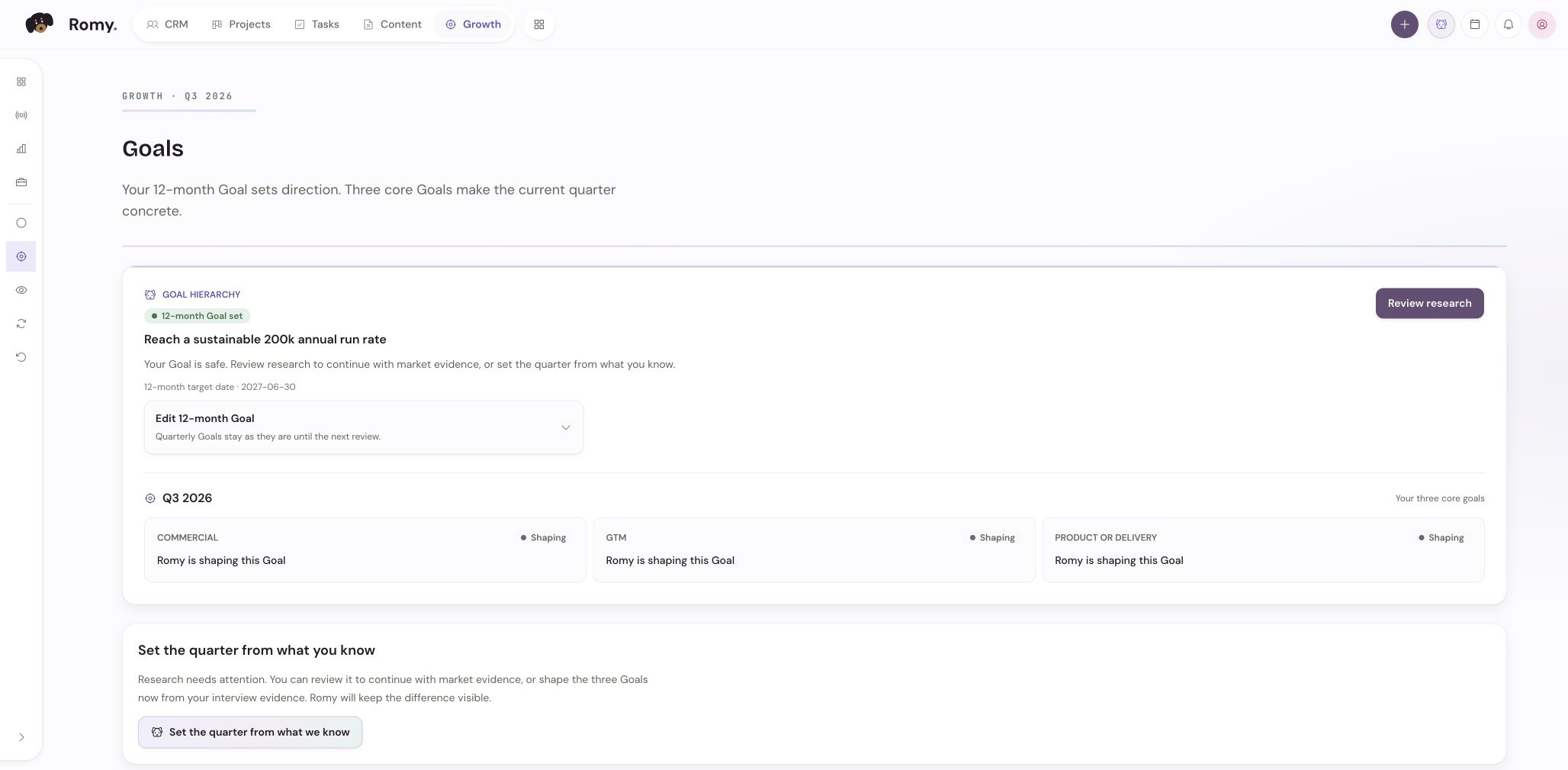
Claude can help you build the system. Romy supplies that commercial system as the product.
Give both products the same difficult brief.
QuietType is a working Mac voice-note app with 300 waitlist signups and four plausible first audiences. (Illustrative company and goal.) The goal: find the first 100 activated paying users within twelve GTM hours per week.
The shared input: work out who QuietType should launch to first and give me the next two weeks of work.
The product builder creates a Claude Project, adds product notes, interview transcripts, competitors, pricing ideas, and brand instructions. They define project instructions for the GTM method and output formats. Claude uses Research and web search to investigate audiences, alternatives, channels, and demand signals. It creates a strategy artifact, audience comparison, launch roadmap, and task file. The product builder uses memory and the Project to maintain context across conversations. Connectors retrieve relevant email, calendar, document, or other context where enabled. Claude drafts content, outreach, files, analyses, and code. Cowork or scheduled tasks maintain recurring work in applicable products. The product builder decides how to store outcomes, update assumptions, rank tasks, and enforce approval. Claude answers: a strong analysis and plan, retained in the Project and extended through the instructions, files, tools, and maintenance system the product builder defines. (Claude workflow: based on official product behavior.)
QuietType enters a defined commercial diagnosis rather than a blank project. Romy stores product, ambition, evidence, constraints, and product builder preferences. It compares the four possible audiences. It recommends the first audience and position, with sources and rejected alternatives. It builds the roadmap, goals, measures, and explicit assumptions. Today ranks the few commercial moves that fit the roadmap and twelve-hour constraint. Content, outreach, and relationship actions draw from the same company state. Every external action waits for approve, edit, or kill. Conversations, activation, payment, and product builder corrections update the commercial context. The next recommendation changes without the product builder manually rebuilding the prompt chain. Romy answers: a strategy stored as product state, connected to the daily queue and a built-in approval and outcome loop. (Romy workflow: current product patterns with illustrative data.)
Independent writers show interest but weak activation. ADHD knowledge workers activate and return. The audience confidence, message, channel priority, and next work change. (QuietType and results: illustrative.)
Claude can also be prompted to update the plan. Romy’s distinction is that the relationship between result, strategy, and next work is a built-in product workflow.
When is Claude the better choice?
Choose Claude when flexibility and broad intelligence matter more than a specialist commercial application.
Claude capability ledger · official product descriptions
- General-purpose research, analysis, writing, and creation
- Coding and software-development work
- Projects, memory, files, retrieval, and connected context
- Flexible user-defined methods, instructions, skills, and systems
- Broad connector and tool possibilities
- Strong one-off and cross-domain problem solving
- A free plan and a lower-priced Pro plan
If you know the GTM method, enjoy building the system, and need broad AI more than commercial defaults, Claude is the rational choice.
When is Romy the better choice?
Choose Romy when the commercial method, structure, and operating discipline are the value.
Romy capability ledger · current product patterns
- A defined diagnosis instead of a blank project
- Audience, position, channels, goals, and assumptions as product state
- Roadmap-driven daily priorities by default
- Relationships, content, tasks, projects, meetings, money, and knowledge connected to GTM
- Every external move under explicit approval
- Product builder judgment and outcomes making the next recommendation smarter
- Less architecture and maintenance for the product builder
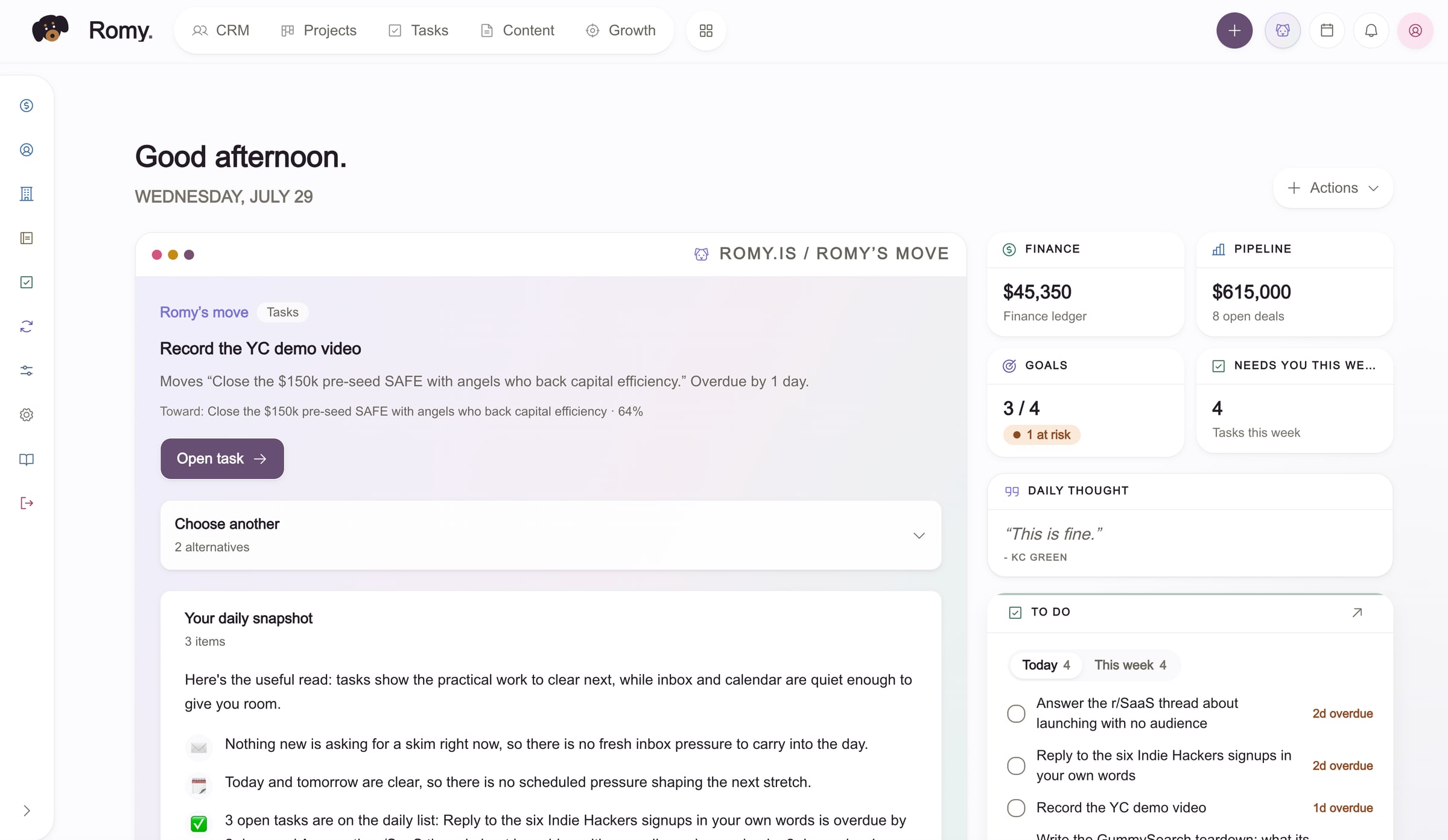
Romy isn’t more raw AI for the money. Its value is the commercial method and operating loop already built into the product.
Comparison table
Eight dimensions where the two products diverge.
Claude costs less if you are willing to build and maintain the system.
Whether one product replaces the other depends on the job. Romy may replace a Claude GTM Project when the product builder no longer wants to maintain prompts, files, tasks, schemas, update rules, and approval conventions. Claude may replace the need for Romy when the product builder knows the method, enjoys maintaining the system, and values broad flexibility and price over specialist defaults.
Both may make sense together. Romy can remain the source of commercial direction while Claude handles general research, coding, analysis, and file creation. (Division of labor: conceptual workflow, not a current native integration.) The current Romy Product page lists Claude as an available integration. Verify what connects, which direction data moves, what permissions apply, and whether the integration is public before relying on it.
Facts checked: 29 July 2026
- Romy
- Free during beta. Billing isn’t open. Planned public-launch price: $49/month, billed monthly, for the complete Romy system.
- Claude Free
- $0.
- Claude Pro (monthly)
- $20/month on monthly billing.
- Claude Pro (annual)
- $17/month equivalent, with $200 billed upfront annually.
- Claude Max
- From $100/month.
Claude Pro is less expensive than Romy’s planned public price and covers far more general-purpose work. Romy’s case isn’t more raw AI for the money. It is the value of the commercial method, structured product state, daily workflow, and lower setup burden.
Does the product builder already pay for Claude? Will Free or Pro cover the work? How much time will maintaining prompts, files, tasks, CRM, outcomes, and governance require? Which external systems are also needed?
Questions
Common questions about Romy, Claude, and how they compare.
Is Romy just a wrapper around Claude?
Claude and Romy are different product layers. A specialist product is the method, state, workflow, controls, and accumulated business context built around model intelligence.
Can I build something like Romy with Claude?
No. Romy calls a harness, a method, state, workflow, and controls based on a strategy corpus of 5,300 documents and your own product context. This is a specific and proprietary system Claude can never access.
Does Claude remember my business?
Depending on how you use it, Claude supports memory, Projects, project knowledge, retrieval, and connectors on current supported plans.
What does Romy store differently?
Romy structures commercial concepts and relationships as product state, including audience, position, channels, goals, work, people, money, and outcomes.
Which is better if I know exactly what to ask?
Claude may be the clearer and less expensive choice, especially if you want broad AI work beyond GTM.
Which is better if I don't know the GTM process?
Romy is the clearer fit because the method and defaults are part of the product.
Can I use both?
Potentially. Use Romy for commercial direction and Claude for broad research, coding, analysis, or creation. Romy's MCP allows you to use Claude to query anything inside your workspace.
Which is cheaper?
Claude Pro is currently cheaper. Romy's planned price is higher because the product sells specialist commercial method and state, not more general-purpose model access.
Does Romy use Claude underneath?
Romy uses a number of model providers depending on the tool required and the task to be done.
Choose flexibility or choose commercial defaults.
Claude product and pricing information was last verified on 29 July 2026from Claude and Anthropic’s official sources. Claude changes quickly; features and prices can change.
Romy’s method is grounded in two decades of commercial go-to-market work and a corpus of 5,300 strategy documents.
Facts checked: 29 July 2026

Want the GTM method and operating loop built into the product?
Join Romy early access to turn your product context into the roadmap, daily commercial work, approval, and outcome loop.