

Romy vs Apollo
Romy vs Apollo: which should a solo founder use?
Apollo helps B2B teams find, enrich, contact, and manage buyers. Romy works out which market and route a product builder should pursue, then runs that broader go-to-market plan day by day.
Choose Apollo if you know B2B sales is the motion and need people and company data, verified contact details, enrichment, targeting, sequences, dialing, workflows, deliverability, and pipeline execution. It is the better fit when the prospect profile is known, contact data and sales execution are the bottleneck, and a sales-specific operating layer is required.
Choose Romy if you still need to work out which audience to start with, why they should choose the product, whether outbound is the right route, and what else belongs in the commercial plan. It is the better fit when the first market is still uncertain, the channel mix isn’t chosen, and the product builder needs the whole roadmap around the product.

What does Apollo actually do?
Apollo is more than a contact database. Its current product combines B2B people and company data with enrichment, targeting, research, engagement, workflow, reporting, and pipeline execution. Apollo’s AI Assistant can use saved context to build and refine audiences, prioritize accounts, research buyers, prepare sequences, recommend workflow changes, and preview changes before they are applied.
Both products can use company context, reason about an audience, recommend work, and help prepare outreach. That overlap is genuine. But the boundary sits in one place: Apollo answers strategic questions inside a B2B sales workflow. Romy decides whether that workflow belongs in the roadmap at all.
The first useful output is different.
The products overlap because both can help a product builder target and act. They diverge in what the system assumes and what it is built to maintain.
- The starting assumptions differ. Apollo starts with B2B revenue work. Romy first determines the market and route that fit the product.
- The primary assets differ. Apollo’s core asset is sales data and execution infrastructure. Romy’s is the living GTM roadmap and connected company context.
- The scope of each loop differs. Apollo optimizes prospecting, engagement, and deal execution. Romy connects sales with content, relationships, operations, money, knowledge, and non-sales channels.
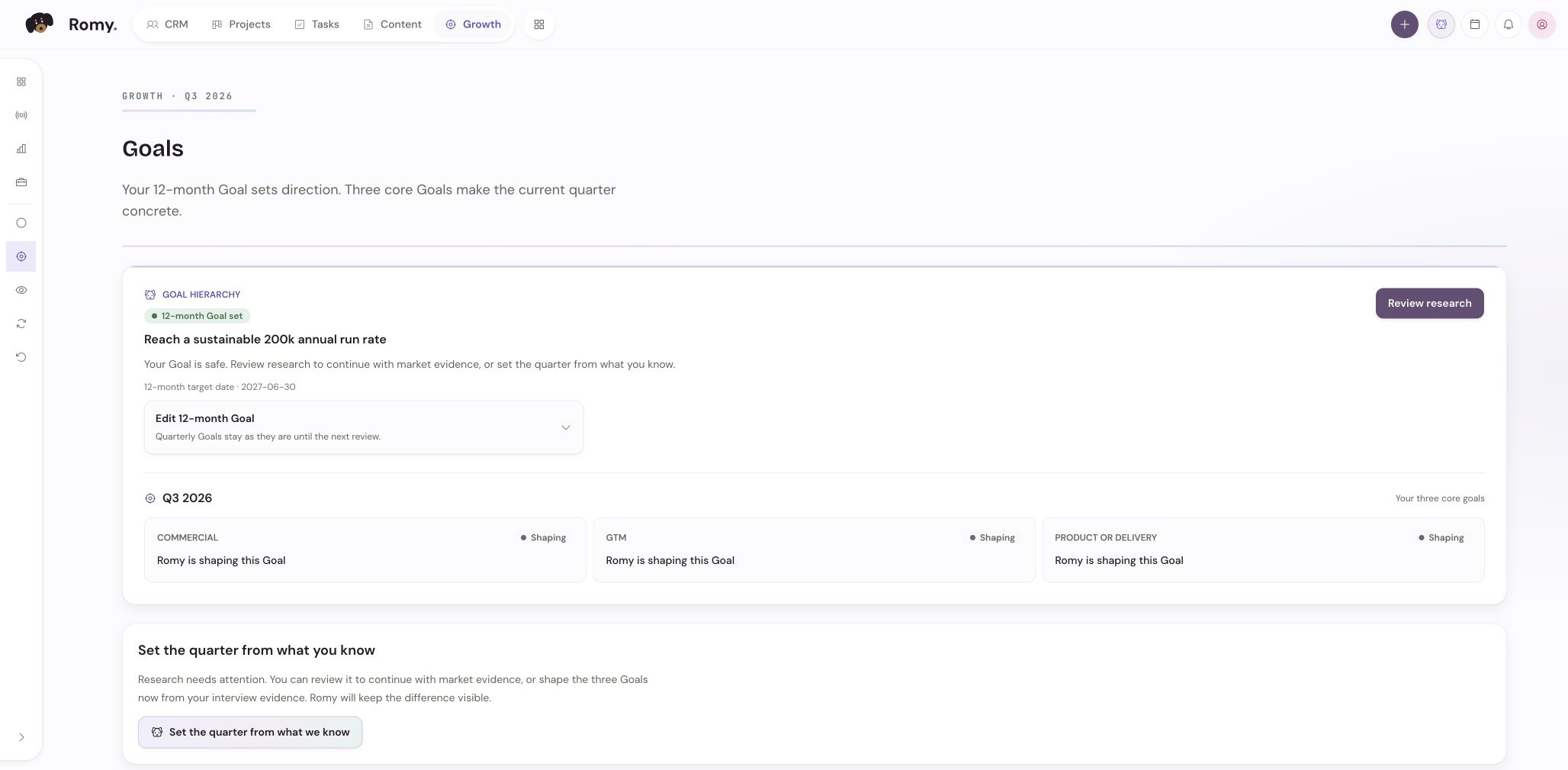
The choice isn’t strategy or no strategy. It is strategy within a sales system or the wider decision about which commercial system to run.
One founder. One prompt. Two different jobs.
Consider a newly launched compliance-evidence SaaS with three design partners and no repeatable customer motion. (Illustrative company and goal.) The goal: find the first repeatable source of qualified conversations within ten GTM hours per week.
The shared prompt: find the first ten compliance consultancies likely to need live evidence sync.
Apollo configures the business, buyer, and offer context, builds a target segment, and identifies and prioritizes accounts and decision-makers. It researches and enriches them, prepares a sequence, and previews recommendations. The B2B sales workflow runs, and Apollo reviews sales performance. Apollo answers: which companies and people match, how can they be enriched, and how should the sales motion reach them? (Apollo workflow: based on official product descriptions.)
Romy compares three plausible audiences, and the product builder chooses the first audience and position. It compares outbound with content, communities, partnerships, and product-led routes, then defines one bounded test. Today’s action is ranked, the product builder approves the external action, and Romy uses conversations, activation, and non-response to update the roadmap. Romy answers: is this the right first audience and channel, what should the product promise, and what evidence would justify continuing? (Romy workflow: current product patterns with illustrative data.)
If founder-led outbound wins, Apollo is an example of a specialist system that could source verified contacts and run the sales workflow. (Handoff: conceptual workflow, not a current native integration.) Romy chooses the commercial test. Apollo is stronger when the chosen test needs specialist B2B data and sales execution.
When is Apollo the better choice?
Choose Apollo when the route is B2B sales and the missing capability is the specialist infrastructure to find and work the market.
Apollo capability ledger · official product descriptions
The foundation is data:
- B2B people and company search across a large dataset
- Verified emails and phone numbers to reach the people it finds
- Contact and account enrichment
- Signals and targeting
- Account qualification, so time goes to the accounts that deserve attention now
Execution follows directly:
- Sequences and dialing
- Deliverability
- Sales workflows that move outreach from plan to action
- Opportunity and pipeline reporting
- Integrations that carry the process through to revenue
Apollo is built for sales-team governance and scale, and it offers a free plan for testing fit, so a product builder can verify the match before committing budget.
If you need a thousand verified B2B contacts and a system to work them, Apollo is the clearer fit.
When is Romy the better choice?
Choose Romy when deciding the audience, position, route, and sequence is still the commercial work.
Romy lets a product builder compare sales with non-sales routes before committing, and make positioning and channel choice part of the same roadmap. The decision about where to compete and how to reach the market happens before a specific execution tool is chosen.
That roadmap turns into all relevant daily commercial work. Romy connects relationships, content, tasks, projects, meetings, money, and knowledge so that the daily recommendation reflects the business around it. The reason for today’s recommendation stays visible, and the system uses product builder judgment and real outcomes to make the next recommendation smarter. The roadmap connects to today’s ranked work, which produces an approved action, which produces an observed result, which updates audience or channel confidence.
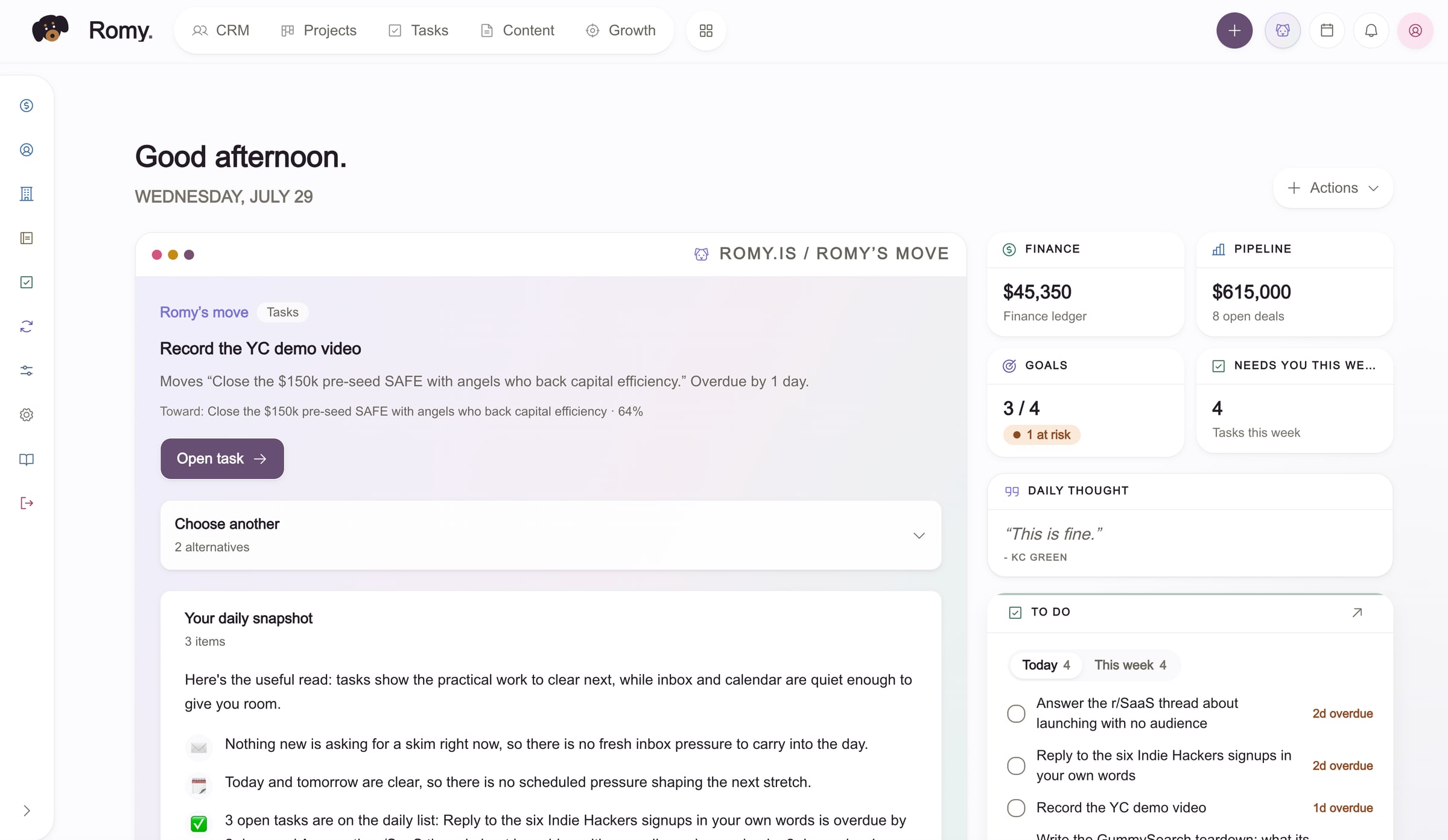
Romy is designed around the full GTM load of a solo product builder, not the specialist execution of one selected motion.
Comparison table
Eight dimensions where the two products diverge.
The same $49 doesn’t buy the same thing.
Whether one product replaces the other depends on the job. Romy may replace the need for Apollo when the product builder’s real need is market, positioning, channel choice, and a low-volume founder-led test rather than a contact database, dialer, sequencer, or sales pipeline. Apollo may replace the need for Romy when the buyer already has the commercial direction and primarily needs B2B data and sales execution.
Both may make sense together. Romy can define the audience, offer, message, test, and success condition. Apollo can provide the specialist data and sales workflow. (Conceptual workflow, not a current native integration.) The risk is real: don’t let two systems independently choose audiences, messages, and external actions without one source of commercial direction.
Facts checked: 29 July 2026
- Romy
- Planned public-launch price: $49/month, billed monthly, for the complete Romy system.
- Apollo Free
- $0. The current official pricing result shows 900 credits per seat per year, granted monthly.
- Apollo Basic
- $49 per user per month, billed annually, with 30,000 credits per seat per year granted upfront.
- Apollo Professional
- $79 per user per month, billed annually, with 48,000 credits per seat per year granted upfront.
- Apollo Organization
- $119 per user per month, billed annually, with a three-seat minimum and 72,000 credits per seat per year granted upfront.
Apollo Basic and Romy’s planned public price can both be $49, but Apollo’s figure is per seat, billed annually, and connected to a credit model. Romy’s planned price is monthly for the full GTM system and isn’t yet a paid public plan.
How many seats? Which actions consume credits? Are add-ons, mailboxes, domains, or sending infrastructure needed? Is the product builder buying sales execution or the wider GTM system?
Questions
Common questions about Romy, Apollo, and how they compare.
Is Romy an Apollo alternative?
Romy can be an alternative when the real need is choosing and running the broader GTM strategy. It isn’t a like-for-like alternative to Apollo's B2B contact data, enrichment, sequencing, dialing, or sales execution.
Can Apollo help create an ICP?
Yes. Apollo's AI Assistant can build and refine audiences and total markets, prioritize accounts, and identify decision-makers inside a B2B sales system.
Does Romy provide verified contact data?
Don’t assume it does. Romy's primary job is selecting and running the commercial direction, not supplying Apollo's specialist contact-data asset.
Does Apollo do strategy?
Yes, within sales. It can help decide who to target, what to prioritize, what to send, and what to do next.
Which is better before I know my sales motion?
Romy is the clearer fit because choosing the motion is the job.
Which is better when I need verified B2B contacts?
Apollo is the clearer fit because specialist B2B data and sales execution are core capabilities.
Can Romy and Apollo work together?
Conceptually, yes. Romy can define the test and Apollo can supply data and execute the B2B workflow. No native integration is implied.
Why are both prices shown as $49?
Apollo Basic is $49 per user per month with annual billing and credits. Romy's planned price is $49 per month for the full system and billing isn’t open.
Does Apollo require review for AI recommendations?
Apollo says its AI Assistant recommendations are preview-first. Approval alone isn’t the category difference on this page.
Choose the system that fits the decision you have already made.
Apollo product, AI Assistant, plan, and credit information was last verified on 29 July 2026from Apollo’s official pricing and help resources. Features, credits, and prices can change.
Romy’s method is grounded in two decades of commercial go-to-market work and a corpus of 5,300 strategy documents.
Facts checked: 29 July 2026

Still deciding who to target and how to reach them?
Join Romy early access to build the market, position, route, and daily commercial roadmap around your product.