

Romy vs Clay
Romy vs Clay: which should a solo founder use?
Clay gives technical GTM teams powerful data, agents, and workflow building blocks. Romy gives a solo product builder the commercial method, roadmap, and daily priorities before that infrastructure is worth building.
Choose Clay if you know the audience and GTM motion, and want configurable workflows that source, enrich, research, score, route, and act on people or company data.
Choose Romy if you need to decide the audience, positioning, channels, goals, and next moves, then keep those choices connected to content, relationships, work, money, and company knowledge.
What does Clay actually do?
Clay can combine multi-provider enrichment, Claygent research, reasoning traces, custom signals, audiences, scoring, sequencing, CRM and warehouse workflows, APIs, and repeatable plays.
Both products can research, reason, use signals, prepare outreach, and learn from results.
Clay is configurable GTM infrastructure. Romy is an opinionated product builder workflow built around a fixed commercial method.
The difference is who defines the system.
- Product posture: Clay gives the user building blocks for a configurable GTM system. Romy recommends and sequences the commercial system.
- Starting state: Clay is strongest when the motion and data job are understood. Romy is designed for ambiguity before the workflow is known.
- Business scope: Clay connects data and execution across GTM systems. Romy connects the commercial roadmap to the whole operating state of a solo product business.
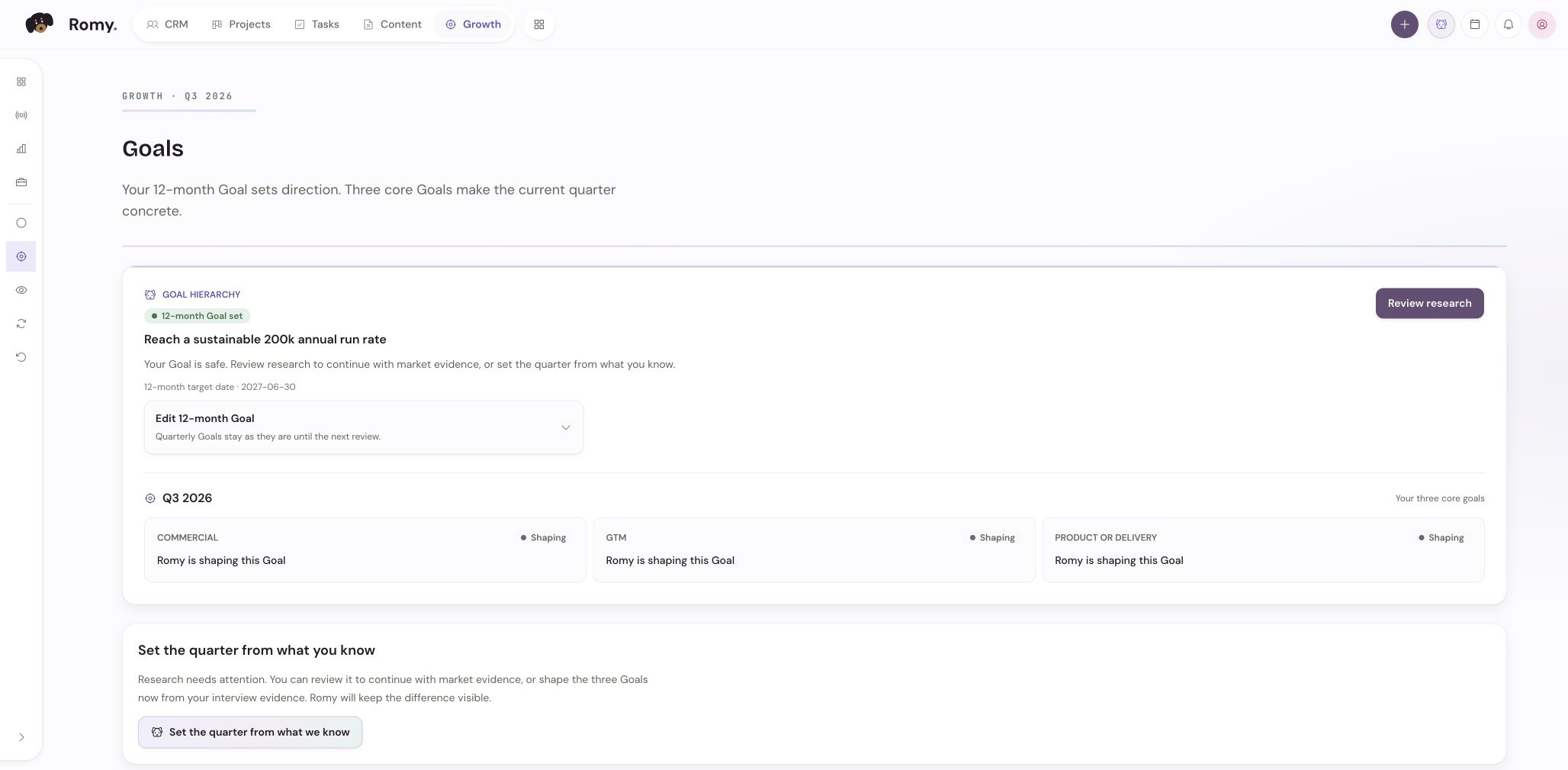
The difference isn’t intelligence versus orchestration. It is who defines the commercial system and what state the product is built to maintain.
Prove the signal before you build the machine.
TraceNest is an open-source tracing tool with 1,800 GitHub stars, sporadic signups, two small paying teams, and no repeatable route to ten paying teams. (Illustrative company and goal.) The shared input: find teams using Framework X that hired a platform engineer in the last 90 days and are discussing tracing costs.
The product builder opens Clay, defines or imports an audience, builds a table, and adds company, role, technology, hiring, and custom signal data. Provider waterfalls query sources in order. Claygent researches company-specific evidence that structured providers don’t supply. The workflow scores and routes accounts based on the chosen conditions. AI copy personalizes a message from the available data. Clay Sequencer or an integration runs the campaign. CRM and workflow destinations receive the result. (Clay workflow: based on official product descriptions.)
Clay answers: how do we source, enrich, research, score, and route these accounts?
TraceNest enters a defined commercial diagnosis rather than a blank table. Romy reads the product, repository signals, paying-user evidence, and product builder constraints. It compares three possible audiences. It decides whether signal-led outbound, partnerships, technical content, community, or product-led conversion is the first experiment. It defines a 20-account test, ranks Today, prepares the action, and waits for approval. Conversations, activation, objections, and payment update confidence. (TraceNest and results: illustrative.)
Romy answers: are these accounts and this signal the best first bet, what promise should the test examine, and what result would change the roadmap?
Romy chooses the bounded commercial experiment. Clay is stronger when the selected experiment needs reliable data and execution infrastructure. (Handoff: conceptual, not a current native integration.)
When is Clay the better choice?
Choose Clay when the motion is understood and configurable data and workflow infrastructure is the job.
Clay capability ledger · official product descriptions
- Multi-provider data enrichment and ordered waterfalls
- Claygent record-level research with reasoning traces
- Custom signals, audiences, and scoring
- Tables, functions, conditions, and bring-your-own API keys
- CRM synchronization, data warehouse workflows, and APIs
- Native sequencing and integrations
- Reusable GTM systems and technical scale
If the workflow is known and needs to be operationalized, Clay is the clearer specialist choice.
When is Romy the better choice?
Choose Romy before the product builder knows which workflow deserves to exist.
Romy capability ledger · current product patterns
- A defined commercial method before the product builder creates one
- Audiences and channels compared, not assumed
- The reason for each move visible and inspectable
- The roadmap turned into a small daily queue
- Content, relationships, work, money, and knowledge connected to the decision
- Every external move under explicit product builder approval
- Product builder judgment and outcomes making the next recommendation smarter
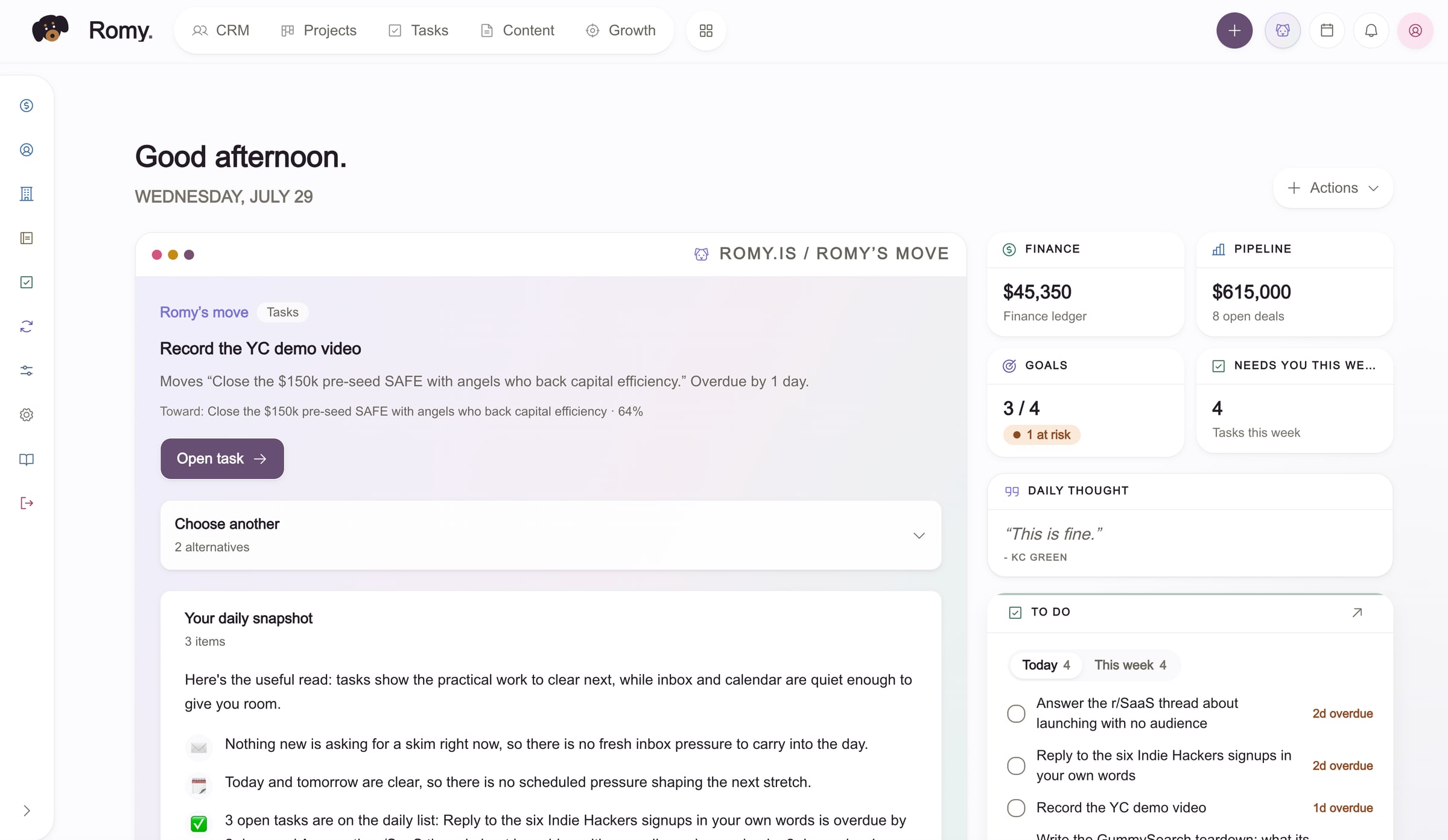
Romy doesn’t replace Clay’s data infrastructure. Its value is the commercial method, daily queue, and operating loop already built into the product.
Comparison table
Eight dimensions where the two products diverge.
Clay prices the workflow as well as the plan.
Whether one product replaces the other depends on the job. Romy may replace Clay when the product builder needs commercial direction and low-volume daily priorities rather than a configurable data workflow. Clay may replace Romy when the motion is settled and the primary job is data, enrichment, orchestration, and execution.
Both may make sense together. Romy can select and govern the experiment while Clay implements the repeatable data workflow. (Conceptual workflow, not a current native integration.) Don’t automate a signal, audience, or message in Clay while another system independently changes the commercial thesis.
Actions measure platform work. Data Credits pay for third-party data and some AI use through Clay’s marketplace. Romy’s planned price doesn’t buy Clay’s data marketplace or workflow capacity.
Facts checked: 29 July 2026
- Romy
- Free during beta. Billing isn’t open. Planned public-launch price: $49/month, billed monthly, for the complete Romy system.
- Clay Free
- $0; currently 100 Data Credits and 500 Actions per month, with up to 200 rows per table.
- Clay Launch
- Starts at $185/month on monthly billing or $167/month annual equivalent; entry capacity currently includes 2,500 Data Credits and 15,000 Actions per month.
- Clay Growth
- Starts at $495/month on monthly billing or $446/month annual equivalent; entry capacity currently includes 6,000 Data Credits and 40,000 Actions per month.
- Clay trial
- Current pricing offers a 14-day trial.
Clay’s cost depends on both the plan and the workflow volume. Romy’s planned price is a single monthly product price, but it doesn’t buy Clay’s data marketplace or automation capacity.
How many records and steps? Which providers consume Data Credits? Are own keys used? How often does the workflow run? Which paid-tier feature is required?
Questions
Common questions about Romy, Clay, and how they compare.
Is Romy a Clay alternative?
Only when the job is commercial direction and daily priorities. Romy isn't a like-for-like replacement for Clay's enrichment, providers, tables, APIs, or automation.
Does Clay do strategy?
Clay can research, reason, score, and support strategic GTM workflows. Romy supplies a fixed method for choosing the wider commercial direction.
Can Clay create an ICP?
Clay can source, enrich, research, score, and model target audiences using the criteria and data in the workflow.
Does Romy enrich contacts?
Yes, Romy enriches contacts.
Which is better for a solo technical product builder?
Clay when the workflow is known and configurability matters; Romy when the product builder needs the commercial choices first.
What are Actions and Data Credits?
Actions measure platform work. Data Credits pay for third-party data and some AI use through Clay's marketplace.
Can they work together?
Conceptually, yes. Romy can choose the experiment and Clay can implement the data workflow. No native integration is implied.
Which is cheaper?
Romy's planned public price is lower than Clay's paid entry tier, but Clay has a free plan and the products buy different jobs.
Build the workflow after you choose the commercial bet.
Clay product and pricing information was last verified on 29 July 2026 from the official sources linked above. Clay introduced its current Actions and Data Credits model in March 2026. Features and prices can change.
Romy’s method is grounded in two decades of commercial go-to-market work and a corpus of 5,300 strategy documents.
Facts checked: 29 July 2026

Need the commercial roadmap before the GTM workflow?
Join Romy early access to turn your product context into the commercial direction, roadmap, daily work, and outcome loop.