Somebody can - and will - compare your product with its competitors, read reviews, check the price and make a shortlist before you know they exist. And the way they do this has hugely changed over the last couple of years.
In G2's March 2026 survey of 1,076 B2BBusiness to business: a product or service sold by one business to another. software buyers, 51% started their research with an AI chatbot powered by a large language model (LLM)The type of AI behind tools such as ChatGPT and Claude, which can answer questions, summarize information and compare options from written instructions. more often than Google, while 71% used one somewhere in the process.
But although the new routes begin with AI, the final decision is still with a person. Gartner found that 69% of 645 B2B buyers preferred to check AI information with a sales rep, and TrustRadius found that 54% of technology buyers even spoke with a userThe person who uses the product. They may or may not be the person who pays for or approves it. of the product before buying. These figures don't describe every market, but your marketing must be both clear to AI, and believable enough to a person.
Buying for work is still buying
Business language can make a purchase sound more mechanical than it might be. A company has a business case, budget and approval process; inside it, a person with an entirely intact nervous system is still wondering whether the product will work, whether changing systems will become a huge headache, and whether they'll look foolish for recommending it.
There are only a few emotional and psychological differences between business and personal purchases. Confidence, relief, hope, pride, desire, aspiration, and anxiety don't disappear just because you're buying software instead of a pair of shoes; instead, they're re-named assurance, efficiency, reputation and perceived riskWhat a buyer believes they could lose or get wrong through a purchase, such as money, time, privacy, control, reputation or customer trust..
Lerner, Li, Valdesolo and Kassam's 2015 review explains how emotions affect the way people judge risk and choose between options, although it doesn't support the idea that everyone buys emotionally and invents the logic later. Your customer may want to feel in control, confident in front of their boss, or relieved that an annoying job is done, so their words and actions decide which feeling belongs in your positioning.
Start with a purchase you remember
Think about the last time you spent roughly what you're asking your customer to spend; a $12 app won't tell you much about a $5,000 spend.
Write down what started the search, what you were using, the result you wanted, what you feared getting wrong, what you trusted, how you judged the price, what delayed you and what finally made you pay.
This puts you in the purchaser's shoes for a moment. It isn't customer evidence - you may have different authority or tolerance for trying something new. Use it to find questions, then let customer conversations, payments and behavior correct it.
What has to happen before somebody says yes
Before money changes hands, a customer decides why they should look now, if changing is worth it, and the risks they might face (as well as anyone else they may have to convince). A sale can stop at any one of these points, even when they want the product. This table shows what you need to find out.
| What the customer is working through | What you're trying to learn |
|---|---|
| Something has changed | Why are they looking now? A missed target, new client or growing cost can be the buying trigger that makes the problem harder to ignore. |
| Their current arrangement has advantages | What do they do today, and why keep it? Another product, manual work or doing nothing may be cheaper and sensible. |
| They want a practical and emotional result | What needs to improve, and how do they want to feel afterwards? The practical result is functional value; confidence, relief or pride is emotional value. |
| They can picture what might go wrong | Are they risking money, time, privacy, control, customer trust or reputation; can they reverse the decision? |
| The right people can agree | Who has the problem, who'll use the product and who can release the money? Add roles only when the sale includes them. |
| The proof answers the concern | Which proof answers their worry? A demo shows the product working; a pilot reduces implementation fear; a relevant customer reference shows that people like them trust it. |
In a simple card purchase, the user, buyerThe person who controls or releases the money for a purchase., championSomebody inside an organization who wants the product and helps it move through the buying process. and approverThe person who has the final authority to accept or reject a purchase. may be one person; in a larger sale, the user can love the product while the buyer can't explain its cost and the approver worries about data.
A row of logos won't answer whether you can import a customer's data, and a demo won't show how you respond when something breaks. The proof needs to match the reason the person might walk away.
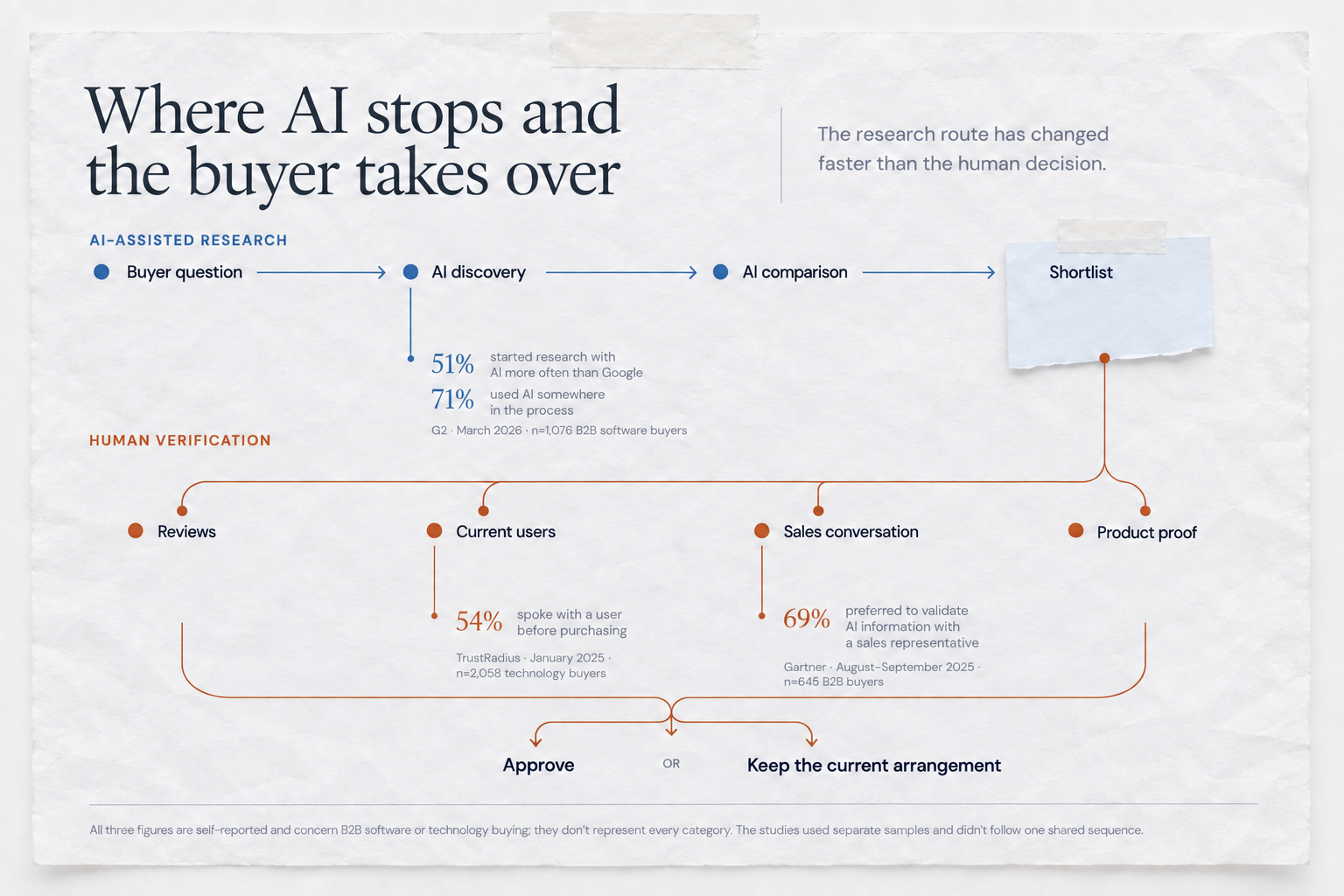
Where AI stops and the buyer takes over
The research route has changed faster than the human decision.
Price says more than the number
Pricing psychologyHow the price, the way it is presented and the choices around it affect what a customer assumes about an offer and how they decide whether to buy. is how the price and choices around it affect what a customer thinks they're buying. The same $49 can look cheap, expensive, reassuring or worrying depending on whether they compare it with the alternatives. This reference priceThe amount a buyer uses to judge whether a price feels high, low or reasonable; it may come from another product, a current workaround or the cost of the problem. may have little to do with what your product costs to run or to make.
Price can also suggest quality or the customer you expect to serve (a price-quality cueThe information a buyer may take from a price about the likely quality, seriousness or intended customer of an offer.), while usage charges create concern when the buyer can't predict the final bill.
Pricing advice suggests showing a high number first (anchoringThe tendency for an earlier number or piece of information to influence a later judgment, including how somebody assesses a price.), adding an inferior third option (the decoy effectA change in preference caused by adding an option that compares poorly with one existing choice. It's an observed effect, rather than a result every pricing page can expect.), or ending prices in .99 (charm pricingPricing just below a round number, such as $9.99 instead of $10. Its effect depends on the product, buyer and context.). None guarantees more sales, and choice overloadThe idea that too many options can make choosing harder. Research shows that the effect changes considerably by situation, so fewer options aren't always better. research doesn't show that fewer options always sell more. Tiers should reflect real differences in volume, support, access or need.
The table keeps what a customer may think separate from what they've told you or done:
| What they see | What they may think | What you need to learn | What to test |
|---|---|---|---|
| One low price | Easy, or too basic | Their comparison | Clearer proof |
| Usage pricing | Fair, or unpredictable | Whether uncertainty stops them | A monthly example |
| Three real tiers | One should fit | Whether they reflect real needs | Customer-led boundaries |
| A deadline | A reason, or pressure | Whether it's real | State the reason |
A hook asks for attention; the rest has to repay it
A hookThe headline, opening sentence, image or idea that gives the right person a reason to pause and continue with a piece of marketing. is the headline, opening sentence, image or idea that grabs your customers' (or intended customers') attention. Its job is to give the right person a reason to pause and find out more; once they do, your positioning should show them why you're the best solution to their problem. That positioning should support your hook.
If a dog groomer has lost a long appointment, “Stop letting clients steal your time” may attract attention; it also accuses their customers of theft. “A missed two-hour groom leaves a two-hour hole in your day” names the situation without pretending every client is careless, leaving the position and proof to explain the product. These words, and the emotional reactions they prompt, matter more than you might initially think.
The post, homepage and personal message don't need identical wording, although the problem, result and reason to believe shouldn't become three versions of what you offer.
The coffee-shop check
How much should you rely on sales psychology, or pulling on emotional threads, to push a sale forward?
A good line to straddle is this: if you wouldn't say a line to a work colleague or an acquaintance you don't know well in a coffee shop, don't use it in a business message. You wouldn't tell them they're failing because they haven't bought, pretend to know their private fears, or announce that everybody else has joined when they haven't; typing it and posting it on the internet doesn't make it less odd.
Fake countdowns, invented popularity, hidden costs, difficult cancellation and confirmshamingWording that tries to make somebody feel foolish or guilty for declining an offer, often in a button or pop-up. (making somebody feel bad for declining) all appear as dark patternsA design choice that steers, pressures or misleads somebody into an action they might not otherwise take, such as hidden costs, a fake countdown or deliberately difficult cancellation. in the U.S. Federal Trade Commission's 2022 report Bringing Dark Patterns to Light. A real deadline, limited capacity or known cost of delay can be explained; if you have to manufacture the reason to act, you don't have one.
The appointment-deposit decision
For the appointment product, the dog groomer wants fewer losses from missed appointments and less uncertainty around the week's income. Taking no deposit costs nothing to set up and avoids the worry that regular customers will find a deposit unfriendly.
The product needs to make the deposit easy and show that the change won't damage the groomer's customer relationships. A working payment link proves the first point; only a real trial and customer response can begin to answer the second. Until then, “clients won't mind” is an assumption.
The price should sit beside the cost of a missed appointment and time spent chasing transfers, using the groomer's figures. The test is whether matching groomers use it on real bookings, continue and pay; compliments don't answer the buying question.
Build your buying-decision map
Complete the buying-decision map for one customer and one purchase. Separate what customers have told you or done, what you've inferred, and what you don't know; then choose one change to the message, proof, price explanation, first step or hook.
The result should be an action you can see: payment, a qualified reply, completing a trial, repeat use, retention or referral. A review date stops a page you'll “keep an eye on” from staying unchanged.
You've finished when the map covers the customer, concern, proof and people; one uncertain part is marked, and one behavior will show whether the change helped.
The next chapter, Choosing a distribution channel, takes that decision to the place your customer is most likely to meet it.
Prompt: build my buying-decision map
Copy this prompt into the model you use. Add your positioning record, customer notes, objections, pricing and any customer behavior you've recorded; write “I don't know yet” where the information doesn't exist.
Build my buying-decision mapShow or hide prompt
I need to understand what has to happen before a customer buys my product, then
choose one part of that decision to test.

Purpose
Build a buying-decision map from my customer evidence. Help me separate what I
know from what I'm assuming, and turn one uncertain part into a test I can run.

When I'm using it
[idea / prototype / lightweight MVP / pre-launch / live]

My context
- Product or service: [what I'm offering now]
- Customer group: [who I'm concentrating on]
- Positioning: [paste my positioning record or current explanation]
- Price and pricing model: [what I charge or expect to charge]
- Current alternatives: [products, people, manual work, AI tools or doing nothing]
- Customer notes and exact words: [paste with dates and sources]
- Objections or reasons people stopped: [paste what actually happened]
- Customer actions: [payments, trials, use, repeat use, retention, referrals]
- Proof I have: [demo, results, references, trial, pilot, policies or other proof]
- People involved in the purchase: [who has the problem, uses, pays, recommends and approves]
- What I still don't know: [list the gaps]
- Time and money I can use for the next test: [my limits]

Your task
1. Extract only the facts and customer language I've supplied.
2. Identify what changed before the customer began looking, or say “I don't
   know yet.”
3. Map the current alternative, including doing nothing, and its real
   advantages.
4. Identify the practical result and possible emotional result supported by my
   material. Treat any emotion I haven't supported as an assumption.
5. Map each real person involved in the purchase. Start with the person who has
   the problem and the person who can release the money; add other roles only
   when my information supports them.
6. For each person, identify what they may lose or get wrong and match that
   concern with proof I have or proof I need.
7. Review what the buyer may compare the price with and whether the final cost
   is predictable. Don't recommend a pricing trick as a general rule.
8. Write three possible messages or hooks. Tie every line to supplied evidence,
   explain which person and concern it addresses, and identify any assumption.
9. Apply this check to every line: would I say it to a work colleague or an
   acquaintance I don't know well in a coffee shop? Remove fake intimacy,
   shaming, invented fear, false urgency, false popularity and unsupported
   personal claims.
10. Recommend one change to test: the message, proof, price explanation,
    lower-risk first step or hook. Name one customer action to watch and a
    review rule.

Rules
- Don't invent customer fears, motives, quotations, results, companies,
  competitors, proof, prices, urgency or willingness to buy.
- Keep facts, customer language, my assumptions, your interpretation,
  recommendations and missing information separate.
- Don't treat my own comparable purchase as customer evidence.
- Don't call the current arrangement irrational; it may be the better option.
- Don't assume the user, buyer and approver are different people.
- Don't treat compliments, stated intent, clicks, trials, payment, repeat use,
  retention and referral as equal evidence.
- Don't present anchoring, tiering, charm pricing, scarcity or another observed
  effect as a guaranteed way to increase sales.
- Don't hide evidence that conflicts with the recommended message.
- Use ordinary language and explain any commercial term I need to know.

Return exactly these headings
## Facts
## Customer language
## Missing information
## What changed
## Current alternative and why they may keep it
## Practical and emotional result
## People involved
## Concern and matching proof
## Price comparison and predictability
## Assumptions to check
## Three messages or hooks
## Coffee-shop check
## One test
## Customer action to watch
## Review rule
Read the answer beside your original notes. A model can organize the decision and expose a gap; it can't tell you what a customer feels without evidence from that customer.
Sources
- G2. “The Answer Economy: How AI Search is Rewiring B2B Software Buying.” Survey of 1,076 B2B software buyers conducted in March 2026. Accessed 14 September 2026.
- Gartner. “Gartner Survey Finds 69% of B2B Buyers Turn to Sales Reps to Validate AI-Generated Insights.” 20 May 2026. Accessed 14 September 2026.
- TrustRadius. “Bridging the Trust Gap: B2B Tech Buying in the Age of AI.” Survey of 2,058 technology buyers conducted in January 2025. Accessed 14 September 2026.
- Lerner, Jennifer S., Ye Li, Piercarlo Valdesolo and Karim S. Kassam. “Emotion and Decision Making.” Annual Review of Psychology, 2015. Accessed 14 September 2026.
- Almquist, Eric, Jamie Cleghorn and Lori Sherer. “The B2B Elements of Value.” Harvard Business Review, March-April 2018. Accessed 14 September 2026.
- Samuelson, William and Richard Zeckhauser. “Status Quo Bias in Decision Making.” Journal of Risk and Uncertainty, 1988. Accessed 14 September 2026.
- Rao, Akshay R. and Kent B. Monroe. “The Effect of Price, Brand Name, and Store Name on Buyers' Perceptions of Product Quality.” Journal of Marketing Research, 1989. Accessed 14 September 2026.
- Huber, Joel, John W. Payne and Christopher Puto. “Adding Asymmetrically Dominated Alternatives.” Journal of Consumer Research, 1982. Accessed 14 September 2026.
- Scheibehenne, Benjamin, Rainer Greifeneder and Peter M. Todd. “Can There Ever Be Too Many Options?” Journal of Consumer Research, 2010. Accessed 14 September 2026.
- Federal Trade Commission. Bringing Dark Patterns to Light. September 2022. Accessed 14 September 2026.
Glossary
Glossary25 terms
The meanings carried by the highlighted terms in this chapter.
- Buying psychology
- How people notice an offer, judge its relevance and risk, compare it with other choices, and decide whether to buy. Chapter definition
- B2B
- Business to business: a product or service sold by one business to another. Chapter definition
- B2C
- Business to consumer: a product or service sold by a business to an individual for personal use. Chapter definition
- Large language model (LLM)
- The type of AI behind tools such as ChatGPT and Claude, which can answer questions, summarize information and compare options from written instructions. Chapter definition
- Buying trigger
- The event or change that makes a customer start looking for a solution now, such as a missed target, new client, deadline, growing cost or repeated problem. Chapter definition
- Status quo
- The customer's current arrangement, including another product, a workaround, manual work or doing nothing. Chapter definition
- Perceived risk
- What a buyer believes they could lose or get wrong through a purchase, such as money, time, privacy, control, reputation or customer trust. Chapter definition
- Emotional value
- How a product changes the way the customer feels, such as making them more confident, relieved, secure, proud or in control. Chapter definition
- Functional value
- The practical result a customer receives, such as saving time, reducing cost or completing a job more accurately. Chapter definition
- User
- The person who uses the product. They may or may not be the person who pays for or approves it. Chapter definition
- Buyer
- The person who controls or releases the money for a purchase. Chapter definition
- Champion
- Somebody inside an organization who wants the product and helps it move through the buying process. Chapter definition
- Approver
- The person who has the final authority to accept or reject a purchase. Chapter definition
- Social proof
- Evidence that other people or organizations have chosen, used or benefited from a product, such as a relevant review, reference or case study. Chapter definition
- Reference price
- The amount a buyer uses to judge whether a price feels high, low or reasonable; it may come from another product, a current workaround or the cost of the problem. Chapter definition
- Pricing psychology
- How the price, the way it is presented and the choices around it affect what a customer assumes about an offer and how they decide whether to buy. Chapter definition
- Anchoring
- The tendency for an earlier number or piece of information to influence a later judgment, including how somebody assesses a price. Chapter definition
- Price-quality cue
- The information a buyer may take from a price about the likely quality, seriousness or intended customer of an offer. Chapter definition
- Decoy effect
- A change in preference caused by adding an option that compares poorly with one existing choice. It's an observed effect, rather than a result every pricing page can expect. Chapter definition
- Charm pricing
- Pricing just below a round number, such as $9.99 instead of $10. Its effect depends on the product, buyer and context. Chapter definition
- Choice architecture
- The way choices are arranged and explained, including their order, defaults, labels and information. Chapter definition
- Choice overload
- The idea that too many options can make choosing harder. Research shows that the effect changes considerably by situation, so fewer options aren't always better. Chapter definition
- Dark pattern
- A design choice that steers, pressures or misleads somebody into an action they might not otherwise take, such as hidden costs, a fake countdown or deliberately difficult cancellation. Chapter definition
- Confirmshaming
- Wording that tries to make somebody feel foolish or guilty for declining an offer, often in a button or pop-up. Chapter definition
- Hook
- The headline, opening sentence, image or idea that gives the right person a reason to pause and continue with a piece of marketing. Chapter definition